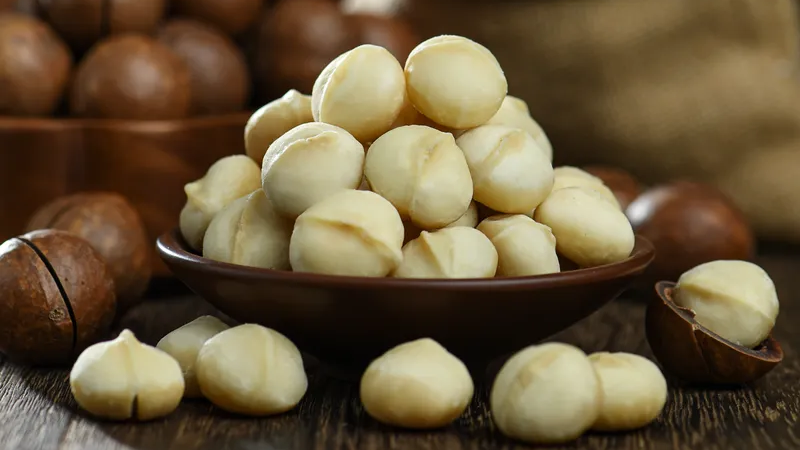
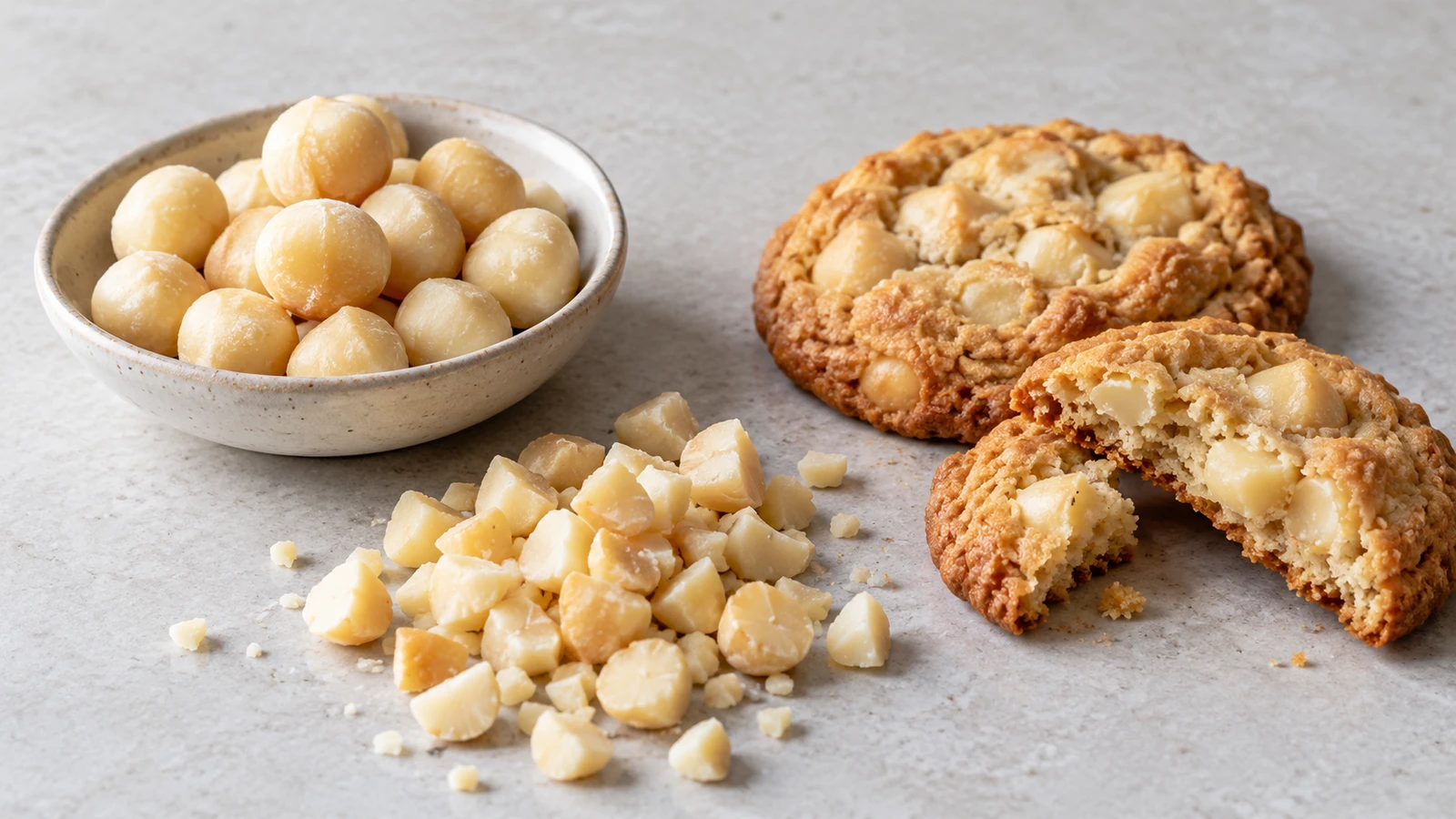
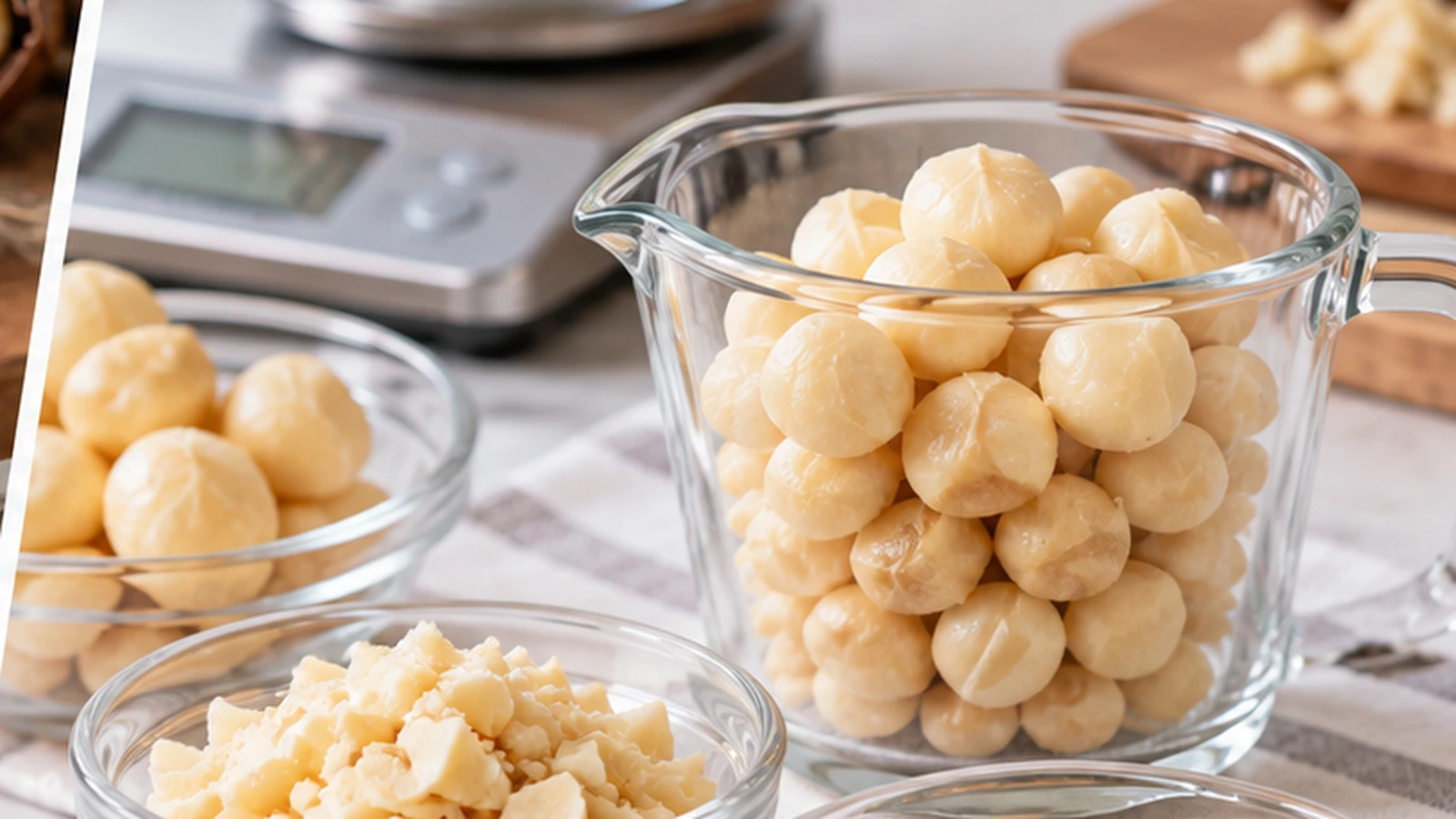
A macadamia nut size chart describes shelled kernels by size range and physical form. To identify a style, read its millimetre range together with the minimum whole- or half-kernel proportion. Size alone does not define the specification: different styles can share a size range while containing different proportions of whole kernels and halves.
This guide uses the World Macadamia Organisation (WMO) kernel style chart and explains how to read it when reviewing a product description or sample. Yunnan Shanshui Walnut Industry Development Co., Ltd. (Yunnan Shanshui) lists whole dried macadamias and fresh macadamias in shell. Establishing which form is being supplied is the first step in choosing the relevant sizing reference.
Macadamia Kernel Size Chart: Styles 0 to 8
The chart below covers macadamia kernels after shell removal. The whole and half percentages are minimum proportions; the size column must be read alongside them. Styles 1S, 4L and 4S are separate entries within the system.
| Style | Kernel composition or form | Size range |
| 0 | At least 95% whole kernels | >20 mm |
| 1 | At least 90% whole kernels | 16–20 mm |
| 1S | At least 90% whole kernels | 13–18 mm |
| 2 | At least 50% whole kernels | >13 mm |
| 3 | At least 15% whole kernels | >13 mm |
| 4L | At least 80% halves | >13 mm |
| 4S | At least 50% halves | 10–14 mm |
| 5 | Pieces | 8–12 mm |
| 6 | Pieces | 5–9 mm |
| 7 | Pieces | 3–6 mm |
| 8 | Fine pieces and meal | <3 mm |
Reference: World Macadamia Organisation, Macadamia Kernel Style Guide, checked 10 October 2026. The guide illustrates premium-grade kernel styles. The table is a sizing reference; available sizes and styles are confirmed separately for an enquiry.
A useful first reading is to locate the required form, then compare the size range and composition. For example, Styles 2 and 3 both specify sizes above 13 mm, but their minimum whole-kernel proportions differ. Those two descriptions should not be treated as equivalent simply because the size column matches.
How Whole Kernels, Halves and Pieces Are Classified
The Shape of an Individual Kernel
Under the WMO description, a whole kernel has not divided into halves. Limited loss is allowed, up to one-quarter of the kernel, provided its outline remains substantially unchanged. A half is approximately one half of a kernel, with no more than one-eighth of its mass missing. These definitions give the terms a more precise meaning than a visual impression of “mostly whole.”
Macadamia nut pieces may result from natural breakage or deliberate dicing. Their classification also depends on size. “Chopped” alone therefore leaves an important question unanswered: how much of the product falls within the required particle range?
Minimum Proportions in a Kernel Style
The shape definition identifies an individual kernel or fragment. The minimum percentage describes the composition of the product being assessed. A style requiring at least 90% whole kernels does not promise that every kernel will be intact, nor does it mean the remaining proportion must be one particular fragment type.
A percentage also needs an agreed measurement basis. Results reported by mass and results reported by count describe different quantities. The specification should identify how kernels are classified, how the proportion is calculated and how the sample represents the supplied material. A product photograph alone does not verify the composition of a supplied lot.
How to Read Millimetre Ranges and Sieve Tolerances
Sieve Openings and Measurement Methods
WMO’s classification guidance relates size ranges to round-hole screens: material passes through the larger opening and is retained above the smaller opening. Alternative sizing methods must provide equivalent sizing results. The stated millimetres describe the screen openings used in that system; they should not automatically be read as the greatest dimension measured with a caliper.
This distinction matters for irregular pieces. A fragment can have a long axis and a narrower cross-section, so its result depends on how size is assessed. When comparing reports, check whether both use the same screening reference or an agreed equivalent method. A visual comparison against a ruler does not establish a sieve result.
Overlapping Ranges and Agreed Tolerances
Style 1 covers 16–20 mm and Style 1S covers 13–18 mm in the WMO guide. Their ranges overlap. Finding one kernel within that shared interval does not identify the style of an entire sample: the declared range and the composition requirements must be considered together.
The same principle applies to macadamia nut halves and pieces. A style describes a product specification, rather than assigning every individual fragment to one exclusive numbered category.
Size tolerances require a separate reading. WMO’s classification text mentions a 10% tolerance for oversized or undersized kernels. That statement must not be converted into a 10% increase or decrease in every listed millimetre dimension. For an order, record how out-of-range material is assessed, including the calculation basis and whether oversize and undersize limits are combined or separate.
The reference document matters too. WMO’s Style Guide writes Style 0 as >20 mm, while the Association of Food Industries specification adopted in November 2025 writes ≥20 mm. Preserve the wording of the document used for the order and agree its measurement method. Mixing values from different charts can create an unintended specification.
How Kernel Style and Quality Grade Differ
Kernel style describes size and physical composition; quality grade addresses other quality criteria. A smaller piece is not automatically a lower-quality ingredient, and a large whole kernel does not establish freedom from defects.
The distinction is explicit in the AFI specification, which applies its style convention to commercial-grade kernels as well. Style numbers should therefore not be read as a quality ranking. When comparing macadamia nut grades, keep these fields separate:
- Style: the size range and required whole, half or piece composition.
- Quality grade: the condition and defect criteria in the adopted specification.
- Processing state: the treatment supplied, such as raw or roasted, where applicable.
Use Yunnan Shanshui’s whole dried macadamia nuts product page to begin an enquiry. Specify whether you need shelled kernels, then match the offered form, size and processing condition to your requirements before assigning a style in the purchase specification. The commercial words “whole” and “dried” do not, by themselves, define every sizing or processing requirement.
Keep In-Shell Nut Sizes Separate from Kernel Sizes
An in-shell measurement includes the shell; a kernel measurement concerns the edible material after shell removal. The two describe different objects. An outside shell dimension cannot be entered directly into the kernel chart to determine a style.
For Yunnan Shanshui’s macadamia nuts in shell, a size enquiry should identify the measurement required for the supplied in-shell product. If the buyer also needs a particular kernel size after cracking, that is a separate requirement to assess using the resulting kernels.
Keeping the two measurements separate prevents a common comparison error: treating a large in-shell nut as evidence of a particular whole-kernel style. Shell dimensions alone do not establish the size distribution, completeness or recovered weight of the kernels.
Turn the Size Chart into a Clear Product Specification
Record the Size Description and Acceptance Basis
The intended product helps determine which part of the chart deserves attention. For a snack or coated nut with a visible whole center, assess both whole-kernel proportion and size consistency. For pieces incorporated into a food, define the particle range that suits the product. The resulting requirement should then be written in terms that the buyer and supplier can assess in the same way.
A size specification should record:
- Supplied form: in-shell nuts, whole kernels, halves, pieces or an agreed blend.
- Reference: the grading document and version, or the agreed supplier specification.
- Style and size: the code and millimetre range, including boundary symbols.
- Composition: required proportions and the basis used to calculate them.
- Measurement and tolerance: the sizing method, permitted departures and how they are assessed.
- Sample identification: the material reference and sampling basis used for the comparison.
Check the Offered Product Against the Same Reference
Compare the supplier’s description and sample record against those same fields. A useful record shows the actual size assessment and composition result alongside the requirement. If a product is offered to a different range or method, resolve that difference before treating it as equivalent. Sample approval should state which material and specification it covers.
Review Yunnan Shanshui’s macadamia nut product range to identify the relevant supply form. Then discuss your macadamia size requirements with the company, providing the intended use, required form, target style or range, reference document and quantity. These details turn a general request for “large” or “whole” macadamias into a product enquiry that can be checked against a clear sizing basis.