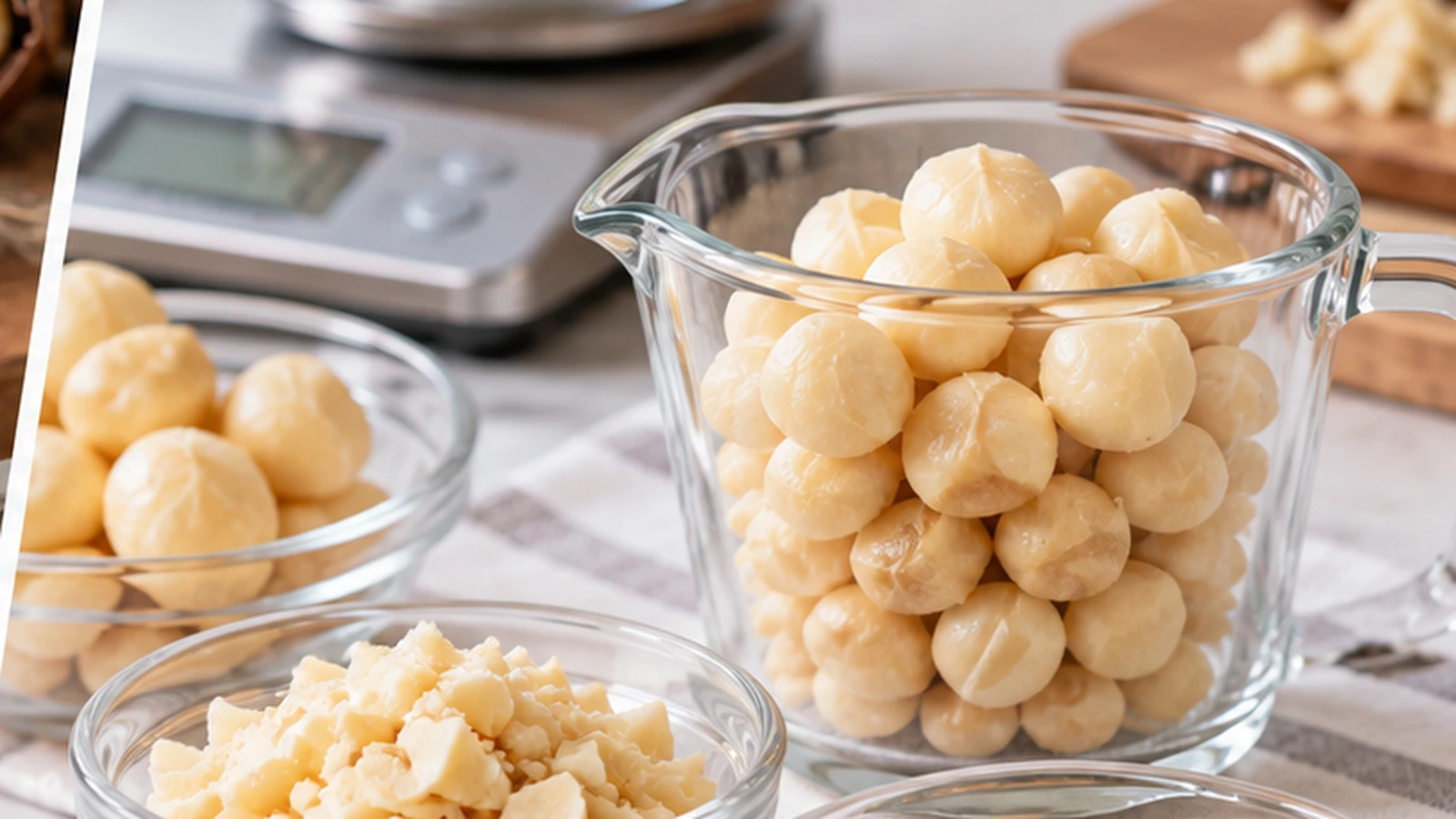
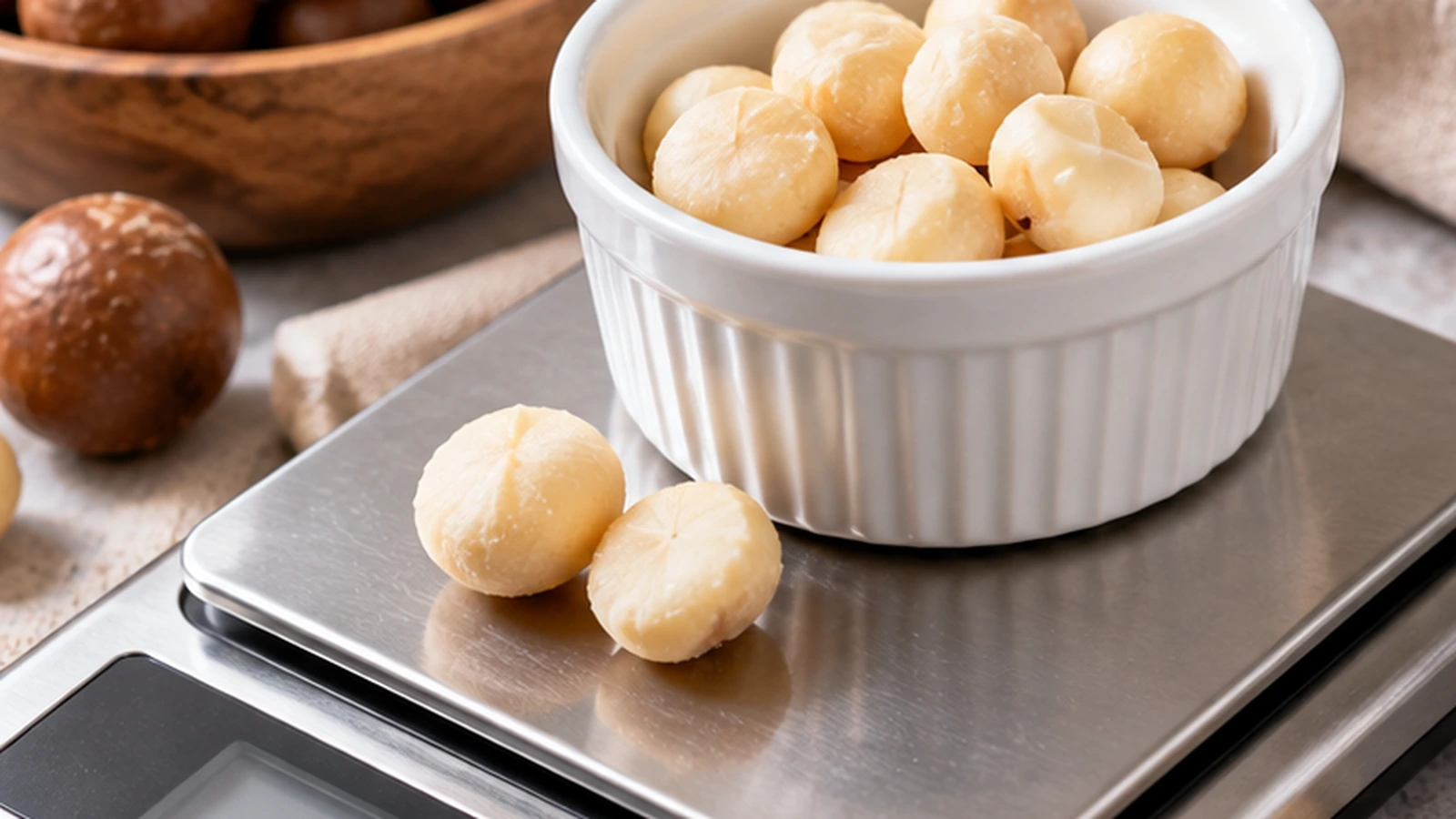
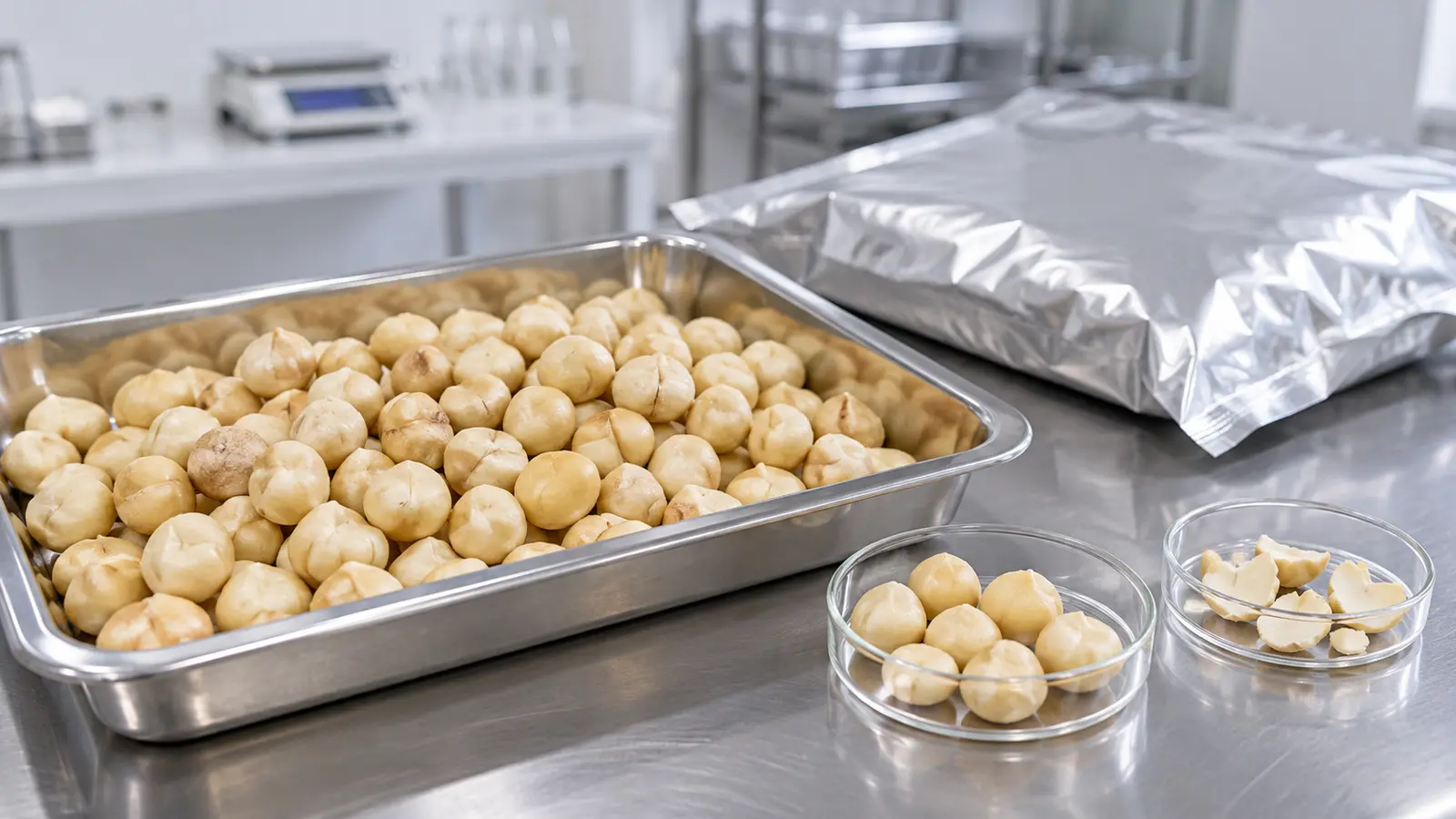
A search for 1 1/4 cups macadamia nuts in grams looks like a simple conversion problem, but commercial food production needs one extra step: define the physical form of the macadamias being measured. Cups measure volume, while grams measure mass. Whole kernels, broken kernels and chopped macadamias can occupy the same cup volume differently, so one universal cup-to-gram value should not be treated as a permanent procurement specification. For bakery and food-manufacturing buyers, the more repeatable method is to weigh the approved product form, establish a gram standard, and scale the recipe from that measured value.
Why Cups and Grams Measure Different Things
A cup tells the production team how much space the ingredient occupies. Grams tell the team how much the ingredient weighs. Those two measures are related through the bulk arrangement of the ingredient, not through a fixed macadamia-specific constant.
That is why searches such as macadamia nuts in grams can produce conflicting numbers across recipe sources. One source may have measured whole kernels; another may have used smaller pieces. Some may level the cup, while others may allow the nuts to settle more densely. If the product form is not stated, the number has limited value for commercial recipe control.
For Shanshui Nut’s B2B customers, this matters because the company supplies macadamia products for food ingredient, wholesale and distribution use. A food buyer needs a conversion that reflects the material actually entering the production line, not an average from an unknown kitchen sample.
Whole Macadamia Nuts and Chopped Macadamias Do Not Fill a Cup the Same Way
Whole kernels leave larger spaces between pieces. When the same material is chopped, smaller particles can occupy part of those spaces. As a result, a cup of chopped macadamias may contain a different mass than a cup filled with intact whole kernels even though the measuring cup itself has not changed.
This is the first variable to lock when converting 1 1/4 cups macadamia nuts into a commercial weight. The recipe should state whether the volume is measured before or after chopping. If the preparation step changes but the old gram conversion is retained, the production batch can drift from the original formula.
Product evidence boundary: Shanshui Nut currently publishes Premium Whole Dried Macadamia Nuts and Factory Bulk Fresh Macadamia Nuts in Shell. The website does not publish a universal gram-per-cup value for kernels, so commercial conversions should be established from the actual approved product form rather than presented as a fixed Shanshui Nut specification.
Kernel Size Changes the Weight Packed Into a Fixed Volume
Even within whole dried kernels, physical size influences how the nuts arrange inside a measuring cup. Larger round kernels can leave different void spaces from smaller kernels. Natural shape variation changes the packing pattern again. That is why a recipe conversion should not assume that every supplier, grade or lot will reproduce the same volume-to-weight relationship exactly.
This becomes important when buyers search for phrases such as 1 3 cup macadamia nuts in grams or 3 4 cup macadamia nuts in grams. The fractional cup changes, but the underlying control issue stays the same: the product form must be defined before the measured volume is converted into a production weight.
For commercial consistency, kernel size and form belong in the ingredient specification, while grams belong in the formulation. Keeping those two controls separate makes it easier to adjust the recipe when the approved ingredient changes.
How Filling Method Changes a Cup-to-Gram Result
Volume measurement is also sensitive to handling. A cup filled gently can contain more open space than a cup that is shaken, tapped or compressed. For free-flowing nuts, small differences in leveling and settling can change the measured mass without any change in the measuring cup.
For a household recipe, that variation may be acceptable. For a bakery making repeated production batches, it creates a source of avoidable inconsistency. This is why commercial formulas normally become more reliable when the team moves away from volumetric measures and records the ingredient in grams or kilograms.
The same principle applies to a search such as 2 tbsp macadamia nuts in grams. A tablespoon is a smaller volume, but the conversion still depends on what form of macadamia fills that space and how the material is handled.
Why Commercial Bakeries Should Convert Cup-Based Recipes to Grams
A cup-based recipe is convenient during product development. It becomes less convenient when the bakery needs to scale production, cost ingredients, manage inventory or reproduce the same formula across shifts. Weight-based batching gives the production team one number that can be multiplied directly with the batch factor.
Shanshui Nut’s premium whole dried macadamia product is described for uses including cookies, cakes, chocolate and ice cream. Those applications often begin with recipe-style measurements, but B2B procurement works more effectively when the ingredient requirement is expressed as a weight per batch and a total bulk requirement.
The production logic is:
measured grams in the approved test recipe × batch multiplier = production ingredient requirement.
This does not require a universal internet conversion. It requires one controlled measurement using the actual ingredient form approved for the recipe.
How to Convert 1 1/4 Cups Macadamia Nuts Into a Production Standard
Instead of asking for one fixed number for every macadamia product, a bakery can create its own repeatable conversion:
- Lock the preparation state. Decide whether the recipe means whole kernels, halves, pieces or chopped nuts.
- Use the same cup-filling method. Level the measure consistently and avoid changing how the product is settled between trials.
- Weigh the filled measure. Record the mass of the macadamias, excluding the container.
- Repeat the measurement. Several trials reveal normal variation and reduce the effect of one unusual fill.
- Create the recipe gram standard. Use the agreed working value for future batches of the same approved product form.
- Recheck after a material change. If the kernel form or approved lot changes materially, confirm that the old volume-to-weight relationship still represents the recipe.
This method is especially useful when an R&D recipe says “1 1/4 cups” but purchasing needs kilograms for a production order.
Recipe Scaling and Ingredient Purchasing Use Different Units for Good Reasons
Recipe development often starts with cups, tablespoons and visual portions because they are quick. Procurement works in larger quantities. A food buyer needs to know how much ingredient is required for the planned number of batches, how that requirement maps to bulk packaging, and how much variation the process can tolerate.
For bulk macadamia nuts for bakery use, the buyer can separate the problem into three levels:
- Recipe level: grams of macadamias per test or production batch.
- Production level: kilograms required per shift, run or order period.
- Procurement level: product form, quantity and packing format required from the supplier.
This hierarchy is more useful than carrying “cups” all the way into the purchase order.
Why a New Supplier or Kernel Form Should Trigger a Conversion Check
If a bakery changes from whole kernels to pieces, or approves a materially different kernel size, the old cup-to-gram conversion may no longer describe the ingredient accurately. The recipe itself may not need to change if it is already controlled in grams; only the R&D reference in cups becomes outdated.
This is one of the strongest reasons to move the production specification to weight. The gram value can remain stable while procurement separately manages size and form. If the product form changes enough to affect recipe behavior, the food-development team can evaluate that as a controlled material change instead of discovering it through inconsistent cup measurements.
A buyer sourcing whole dried macadamia nuts supplier options should therefore compare the offered product form and approved reference before assuming one supplier’s cup conversion can be copied to another.
What Should a Food Buyer Confirm With the Macadamia Supplier?
The supplier does not need to own the buyer’s recipe conversion, but the ingredient specification should give the bakery enough information to maintain its internal weight standard. The buyer should confirm the offered product form, intended application, required quantity, packing expectation and the sample or product reference used for approval.
| Recipe / Procurement Variable | Buyer Control | Supplier Confirmation | Why It Matters |
| Recipe measure | Convert cups to internal grams | Not a supplier-set universal value | Keeps formulation under buyer control |
| Kernel form | Whole / pieces / chopped preparation | Offered product form | Changes volume packing and recipe behavior |
| Reference material | Approved test material | Product/lot reference where applicable | Connects the conversion to actual material |
| Batch requirement | Grams or kilograms per production run | Order quantity / packing confirmation | Connects formulation to purchasing |
| Application | Cookies, cakes, chocolate or other use | Relevant available product form | Supports product selection |
Use the Macadamia Category to Select the Ingredient Form Before Finalizing the Conversion
Buyers can start with the Shanshui Nut Macadamia Nuts category to review the published product forms. For a recipe using kernels, the relevant commercial discussion is different from an in-shell purchase because shell weight and edible kernel weight are not interchangeable.
The broader Shanshui Nut Products page can be used when a food company is comparing macadamias with other nut ingredients in the same sourcing program. Once the recipe has been converted to an internal gram standard, the buyer can send the required product form and bulk quantity through the Shanshui Nut contact page.
A Cup-to-Gram Conversion Should Be a Controlled Recipe Value, Not a Universal Nut Constant
The practical answer to “1 1/4 cups macadamia nuts in grams” is that a commercial bakery should establish the number from the actual product form used in the recipe. Whole-versus-chopped preparation, kernel size and filling method all influence how much mass occupies a fixed volume.
Once the recipe is controlled in grams, the operation becomes easier to scale, cost and purchase. Cups can remain useful in product-development notes, but the commercial specification should move toward measured mass and an agreed ingredient form.