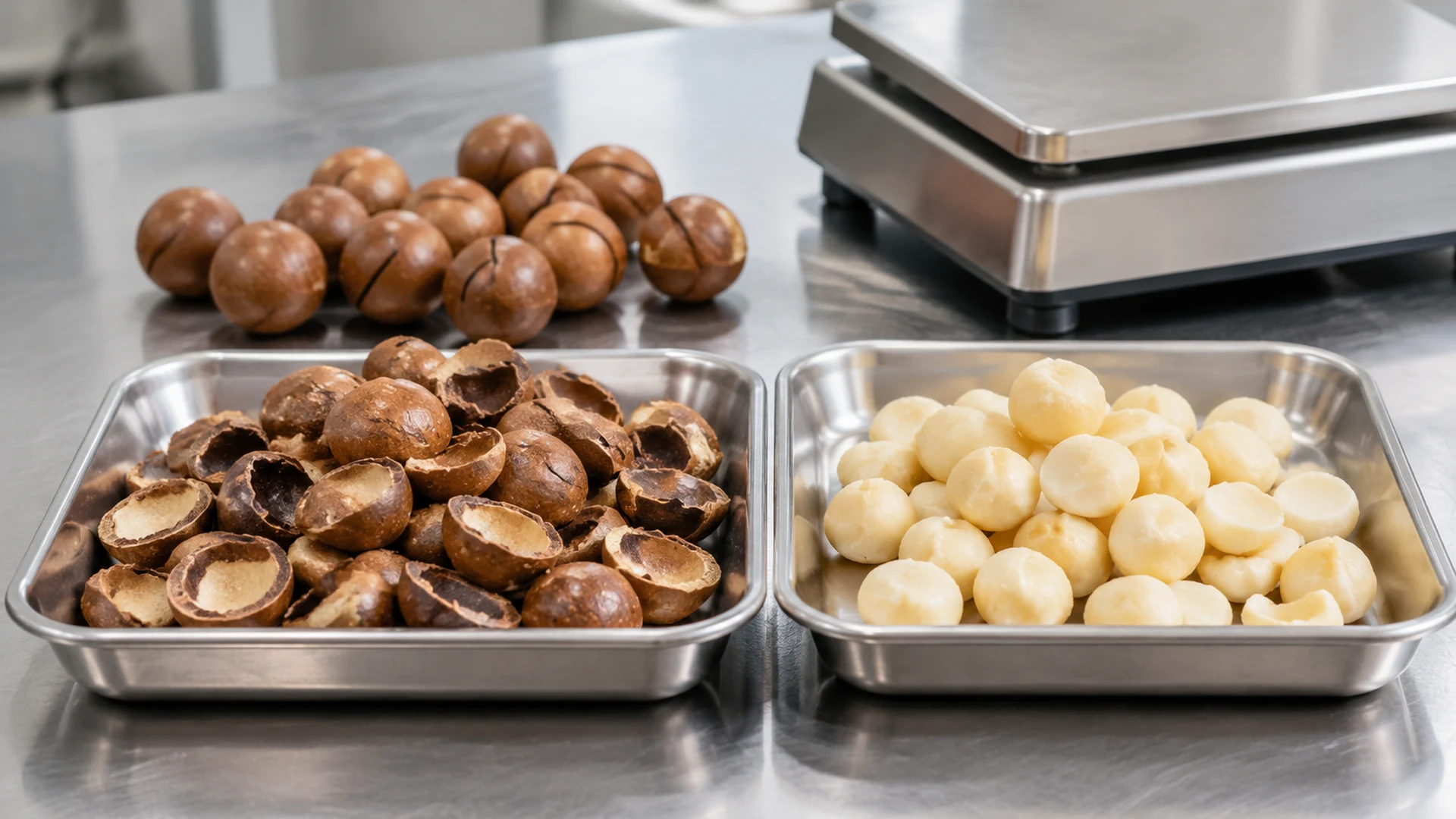
The macadamia nut kernel-to-shell weight ratio compares the mass of separated kernels with the mass of their corresponding shells. It is calculated by dividing kernel mass by shell mass. This differs from kernel percentage, which compares kernel mass with the original in-shell nut mass, and from recoverable kernel yield, which measures the quantity of kernels meeting a defined acceptance specification.
These measurements answer different questions. For bulk buyers and processors, the result is useful only when the sample, the measured fractions, and the calculation basis are clearly defined. A ratio from one sample does not establish a guaranteed value for an entire shipment or future batches.
What Does the Kernel-to-Shell Weight Ratio Measure?
Define the two measured fractions
The kernel-to-shell weight ratio is:
Kernel-to-shell ratio = Separated kernel mass ÷ Separated shell mass
Both masses must use the same unit, such as grams or kilograms. The result is a dimensionless ratio, not a percentage of the original in-shell weight.
For example, if a sample produces 300 g of separated kernels and 700 g of shells, the ratio is 300 ÷ 700 = 0.429, approximately. This means the measured kernel mass is about 0.429 times the shell mass. It does not mean kernels account for 42.9% of the original in-shell sample.
The measurement procedure must define what counts as kernel and shell. Residual material, debris, unaccounted losses, and differences in sample condition can affect the recorded masses. Use the same separation and weighing method when comparing samples.
Distinguish the ratio from kernel percentage
Kernel percentage uses a different denominator. If the separated kernel and shell fractions account for the measured sample mass, with no other material or unaccounted losses, it can be calculated as:
Kernel percentage (%) = Kernel mass ÷ (Kernel mass + Shell mass) × 100
Using the example above, 300 ÷ (300 + 700) × 100 = 30%. The ratio is approximately 0.429, while the kernel percentage is 30%. Both are mathematically consistent because they describe different relationships.
If the measured fractions do not account for the initial sample mass, do not silently assume that the mass balance closes. Record the discrepancy and define whether kernel percentage is calculated from the initial in-shell mass or from the sum of the separated fractions.
How Should Buyers Measure the Ratio from a Sample?
Record the initial sample and the separated fractions
A useful test begins with a clearly identified sample. Record the batch reference, initial in-shell mass, sample condition, and any preparation performed before shelling. After separation, weigh the kernel and shell fractions independently and record any unclassified material or handling loss according to the agreed procedure.
A practical record should include:
- Sample or lot identification.
- Initial in-shell sample mass.
- Separated kernel mass.
- Separated shell mass.
- Relevant sample condition and preparation.
- How residual material and unaccounted losses are treated.
These records make the result easier to repeat and audit. If the measured fractions cannot be reconciled with the initial sample under the chosen method, investigate the discrepancy before using the ratio to compare suppliers or batches.
Keep the sample method consistent
The sample should be relevant to the lot being assessed, and the method should be applied consistently. Differences in sample selection, moisture condition, separation technique, or treatment of residual material can make two reported ratios difficult to compare.
A single sample can illustrate the method or provide an initial indication, but it does not automatically represent a whole shipment. Where variability matters commercially, agree on a sampling plan and whether repeated samples are needed.
How Is Recoverable Kernel Yield Different?
Recoverable kernel yield is useful when the buyer wants to know how much of the original in-shell input becomes kernel that meets a defined acceptance specification. For this article, it is used as an operational measure, not as a claim that one universal industry definition applies to every contract.
Recoverable kernel yield (%) = Accepted usable kernel mass ÷ Initial in-shell sample mass × 100
Suppose the 300 g of separated kernels in the earlier example includes 285 g that meets the buyer’s agreed criteria. If the initial in-shell sample mass was 1,000 g, the recoverable kernel yield is 285 ÷ 1,000 × 100 = 28.5%.
The remaining 15 g does not meet the assumed acceptance criteria in this example. It should not automatically be described as waste; its suitability depends on condition and the intended application. If pieces are acceptable for one product but not another, the same sample can produce different recoverable yields under different specifications.
| Metric | Calculation basis | What it tells the buyer |
| Kernel-to-shell ratio | Kernel mass ÷ shell mass | How kernel mass compares with shell mass |
| Kernel percentage of input | Kernel mass ÷ initial in-shell mass × 100% | What proportion of the input mass is separated kernel |
| Recoverable kernel yield | Accepted usable kernel mass ÷ initial in-shell mass × 100% | What proportion of the input becomes accepted usable kernel |
Do not compare these metrics as if they were interchangeable. A report should state which metric is used, how its numerator and denominator are defined, and which sorting criteria apply.
What Can Make Two Kernel-to-Shell Results Incomparable?
Sample condition and moisture basis
Moisture changes can affect measured mass. If samples are tested under different conditions, the resulting ratios may not provide an equivalent basis for comparison. Record whether the sample is measured as received or after a defined conditioning step. A dry-matter correction is not automatically necessary for every commercial evaluation; the appropriate method depends on the purpose of the test and the agreed specification.
Separation and sorting rules
Kernel-to-shell ratio uses separated kernel mass and shell mass. Recoverable yield additionally depends on which kernels meet the acceptance criteria. If one test includes small fragments and another excludes them, their recoverable yields cannot be compared without accounting for the different definitions.
Before testing, agree how whole kernels, halves, pieces, damaged material, and other relevant fractions will be classified. This is especially important when the intended product requires a specific kernel form.
Mass balance and unaccounted losses
The initial in-shell mass, separated kernel mass, shell mass, and any other recorded fractions should be considered together. A difference between initial mass and the sum of recovered fractions may arise from material left uncollected, moisture changes, or handling losses. The discrepancy should be recorded rather than hidden by assuming the fractions add up exactly.
This matters most when a result is used for commercial comparison or cost calculations. A ratio may still be mathematically calculable from two measured fractions, but an unexplained mass-balance difference can limit what the result says about the original sample.
How Can Buyers Use the Measurements in a Purchasing Decision?
Compare samples on the same basis
Before comparing in-shell macadamia lots, confirm that the same measurement definitions and procedures were used. Record the product and batch identity, initial mass, separated fractions, sample condition, and calculation method. A single sample result should not be treated as a guaranteed value for future deliveries.
Separate raw-material yield from processing cost
A higher kernel-to-shell ratio does not automatically mean a lower cost per unit of usable kernel. If the price of the in-shell material and the accepted usable kernel mass from the same tested quantity are known, a basic raw-material cost can be calculated:
Raw-material cost per unit of usable kernel = Cost of tested in-shell quantity ÷ Accepted usable kernel mass recovered
This calculation covers raw-material cost only. It excludes shelling, sorting, labor, equipment operation, and other processing costs unless those costs are explicitly included. Without reliable cost and output data, the kernel-to-shell ratio alone cannot establish total processing cost or identify the best-value supplier.
What Should Buyers Confirm Before Ordering In-Shell Macadamia Nuts?
- Product identity: Confirm that the product is in-shell macadamia nuts rather than separated kernels.
- Sample identification: Record the sample or lot reference and initial mass.
- Measurement definition: Specify whether the requested result is a kernel-to-shell ratio, kernel percentage, or recoverable kernel yield.
- Separation method: Define how kernels and shells will be separated and weighed.
- Usable-kernel criteria: State which kernel forms and conditions are acceptable if recoverable yield is measured.
- Sample condition: Record relevant preparation and weighing basis.
- Acceptance procedure: Agree how the result will be used to assess the sample or delivered lot.
Shanshui Nut lists Factory Bulk Fresh Macadamia Nuts in Shell as a relevant product page. Buyers should confirm the actual supplied product condition, available specifications, and supporting documentation for the intended application rather than infer a particular kernel-to-shell ratio from the product description.
For product-specific questions or purchasing requirements, buyers can contact Shanshui Nut with the intended product form and proposed measurement criteria.
References
- Lin, C., Zhu, D., Wang, H., and Wu, J. (2026). “Parameter Optimization and Performance Validation of a Cone-Type Macadamia Nut Sheller Based on the Discrete Element Method.” Journal of Food Science, 91(8), e71343. The study concerns a specific cone-type sheller and controlled test material.
- Liang, T., Chou, J., and Knapp, R. (1988). “Notching and Freezing Effect on Macadamia Nut Kernel Recovery.” Journal of Agricultural Engineering Research, 41(1), 43–52.
Contact Shanshui Nut for product information and purchasing specifications.