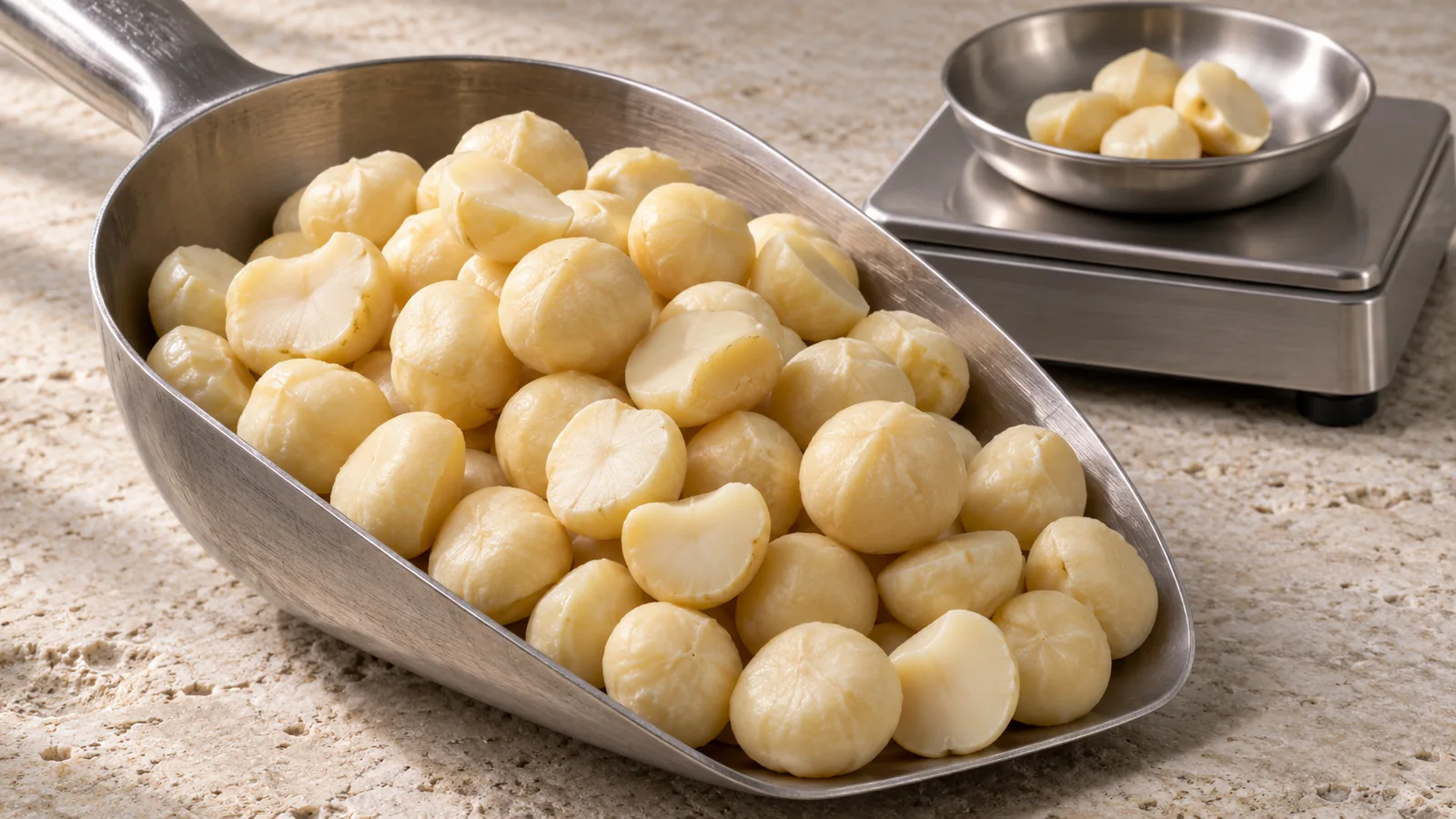
Macadamia kernels contain mostly fat, and most of that fat is monounsaturated. They also supply protein, dietary fiber, magnesium, manganese and thiamin (vitamin B1). USDA’s reference for 100 g of raw, shelled macadamias gives 718 kcal, 75.77 g of fat, 7.91 g of protein and 8.60 g of fiber. About 78% of the fat is monounsaturated. For a snack developer, that profile matters when one nut replaces another: the recipe can gain fat while losing protein, even if the total weight of nuts stays the same.
A buyer asking “what are the nutrients in macadamia nuts?” therefore needs two figures for each nutrient: its concentration in the edible kernel and its contribution at the weight actually used in the product.
Macadamia nutrients per 100 g and per 15 g of kernels
| Nutrient or energy | 100 g of raw kernels | 15 g added to one pack |
| Energy | 718 kcal | 108 kcal |
| Total fat | 75.77 g | 11.37 g |
| Monounsaturated fat | 58.88 g | 8.83 g |
| Protein | 7.91 g | 1.19 g |
| Total carbohydrate | 13.82 g | 2.07 g |
| Dietary fiber | 8.60 g | 1.29 g |
| Total sugars | 4.57 g | 0.69 g |
| Magnesium | 130 mg | 19.5 mg |
| Manganese | 4.13 mg | 0.62 mg |
| Thiamin (vitamin B1) | 1.20 mg | 0.18 mg |
Source — USDA Standard Reference, raw macadamia nuts, NDB 12131. The 15 g column is an illustrative recipe addition calculated from unrounded values. Shell weight is excluded.
Two details matter when entering these figures into a formulation sheet. Monounsaturated fat is part of total fat. Fiber and sugars are already included in USDA’s total carbohydrate figure. Adding the rows together would count some nutrients twice. Also keep grams and milligrams in separate fields: for example, the 15 g addition contributes 19.5 milligrams of magnesium and 1.29 grams of fiber.
How much do macadamias contribute to a snack mix?
Consider a 50 g snack pack that contains 10 g of raw macadamias, 15 g of plain almonds and 25 g of other ingredients. The developer wants larger, more visible pieces of macadamia, so the next trial uses 15 g of macadamias and 10 g of almonds. The remaining ingredients and pack weight stay the same. How should the nutrition estimate change?
Five grams of raw macadamias contributes 35.9 kcal, but the original 5 g of almonds already contributed about 29 kcal. The increase in the pack is only about 7 kcal. The same subtraction gives the change in fat, protein and fiber.
| Per 50 g finished pack | Added with 5 g macadamias | Removed with 5 g almonds | Net change |
| Energy | 35.90 kcal | 28.95 kcal | +6.95 kcal |
| Total fat | 3.79 g | 2.50 g | +1.29 g |
| Protein | 0.40 g | 1.06 g | −0.66 g |
| Dietary fiber | 0.43 g | 0.63 g | −0.20 g |
Source — Calculated from USDA values for macadamias (NDB 12131) and almonds (NDB 12061). Each column is rounded separately. These are recipe estimates.
That result can change the buying decision. If the brief calls for more macadamia flavor and has room for the fat increase, the trial can proceed to tasting. If the customer also needs the original protein level, the team now knows the size of the gap: roughly two-thirds of a gram per pack. Purchasing can take that figure back to development before committing to the revised blend.
The comparison assumes a mix packed without a change in weight during processing. If the kernels go into a baked bar, calculate nutrients for the complete batch and use the measured finished batch weight when expressing them per 100 g. Water lost in the oven changes the weight used in that calculation.
Which figures should you request from the supplier?
Ask for nutrition values for the exact product code being quoted, expressed per 100 g as supplied. The ingredient description determines which numbers deserve a closer look.
| Product on the quotation | What to check before using the figures |
| Plain dried or dry-roasted kernels | Confirm edible kernel weight, preparation and whether the sheet reports values as supplied or on a dry-matter basis. |
| Salted or oil-roasted kernels | Ask for sodium in the seasoned product and the identity of any added oil. Carry the finished ingredient’s fat profile into the recipe. |
| Sweetened or coated kernels | Ask whether the 100 g basis includes the coating. Use the finished ingredient’s sugar and fiber values for the whole inclusion. |
A dry-matter figure is easy to miss when two quotes look similar. Suppose a specification lists 76.0 g of fat per 100 g of dry matter, and the same product contains 2.0% moisture as supplied. In 100 g delivered, there are 98 g of dry matter. On that basis the fat figure is 76.0 × 0.98, or 74.48 g per 100 g as supplied. Both figures can describe the same ingredient. Apply this conversion only when the sheet expressly gives a dry basis and the moisture figure applies to that product.
When reviewing LIRENMEI’s whole dried macadamia nuts, a precise request is: “Please send the current ingredient statement and nutrition specification for the quoted product code. We use 15 g per pack and need values per 100 g of edible product as supplied. Please identify whether the figures are typical database values, a formulation calculation or an analysis of the product.” Keep the dated reply with the approved recipe so a later change in coating, preparation or supplier can be checked against the same basis.