If you’re comparing macadamia suppliers or checking a spec sheet, you’ve probably hit conflicting calorie numbers. Community threads quote figures like 1,000 calories per cup and 1,150 kcal per 5 oz, and it’s hard to tell which one applies to your product. The short answer: macadamias are very energy-dense and high in fat, and the exact figure depends on the serving basis you use. These numbers often differ because they measure different amounts, not because one is wrong.
This guide explains the nutritional value of macadamia nuts in a way procurement and R&D teams can use. We’ll walk through one conversion method (per 1 oz or 10 to 12 kernels, per nut, per cup, per 5 oz, and per 100 g), show where figures can and can’t be verified, and explain which basis your own nutrition panel should use. We’ll also cover which health claims brands can make and how to stay within them.
The goal is not to pick a single “correct” number for macadamias in general. Nutritional values change with the product form, the moisture content, the roasting process, and the weight that was actually measured. A raw, shelled kernel sample and a roasted, salted product can carry different per-gram values, and a bulk ingredient spec may describe a different product altogether. Treating every published figure as interchangeable is the most common source of errors in supplier comparisons and labeling reviews.
Instead, this article gives you a repeatable way to handle the numbers. You’ll see how one verified serving figure can be converted into other common bases, where the arithmetic is straightforward, and where a conversion needs a source you can actually trace. By the end, you should be able to check any macadamia figure you receive, identify whether it is comparable to your own, and understand what you are and aren’t allowed to say about it on pack or in marketing.
Understanding what is the nutritional value of macadamia nuts
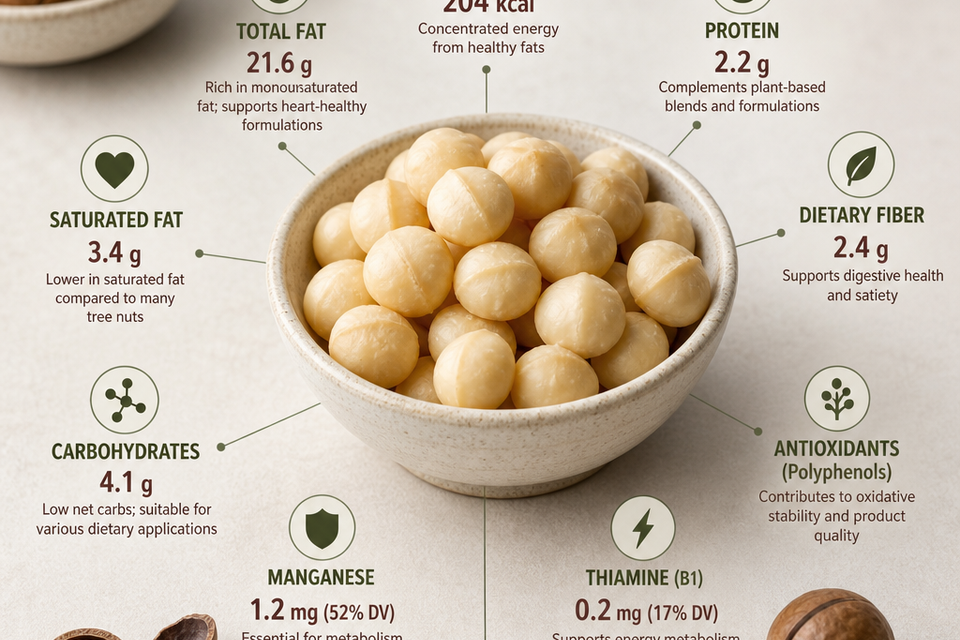
A 1 oz serving of macadamia nuts delivers about 204 calories, mostly from monounsaturated fat, plus meaningful amounts of manganese and thiamine. For sourcing and product teams, the fat profile and micronutrient content are the figures most often used when comparing macadamia against other nut ingredients for formulation or labeling.
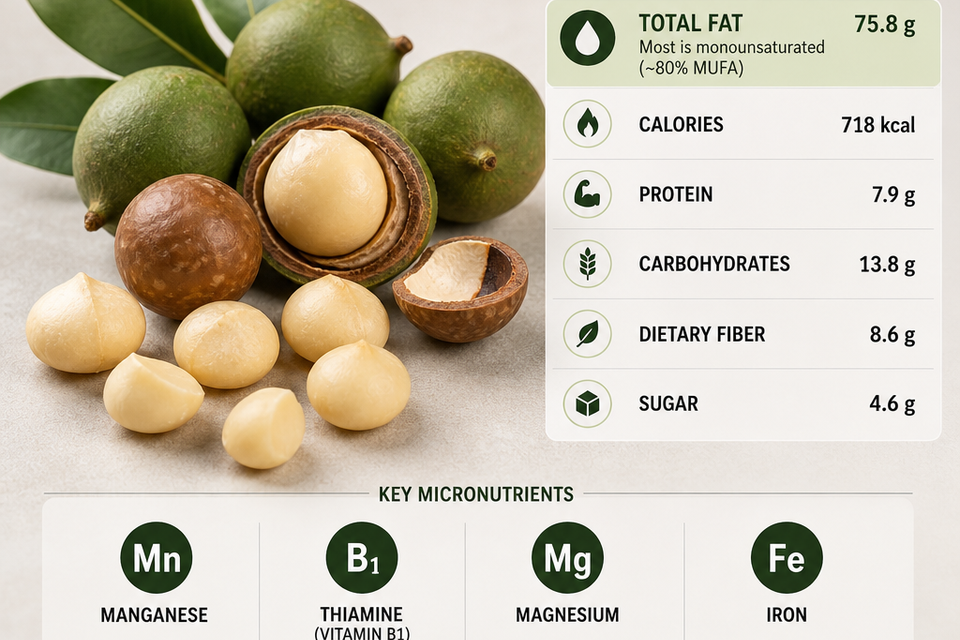
Macadamias are energy-dense and high in monounsaturated fat. Their value for buyers and product developers lies in the fat profile and micronutrient content, so compare per-serving figures against your formulation or labeling targets rather than relying on calories alone.
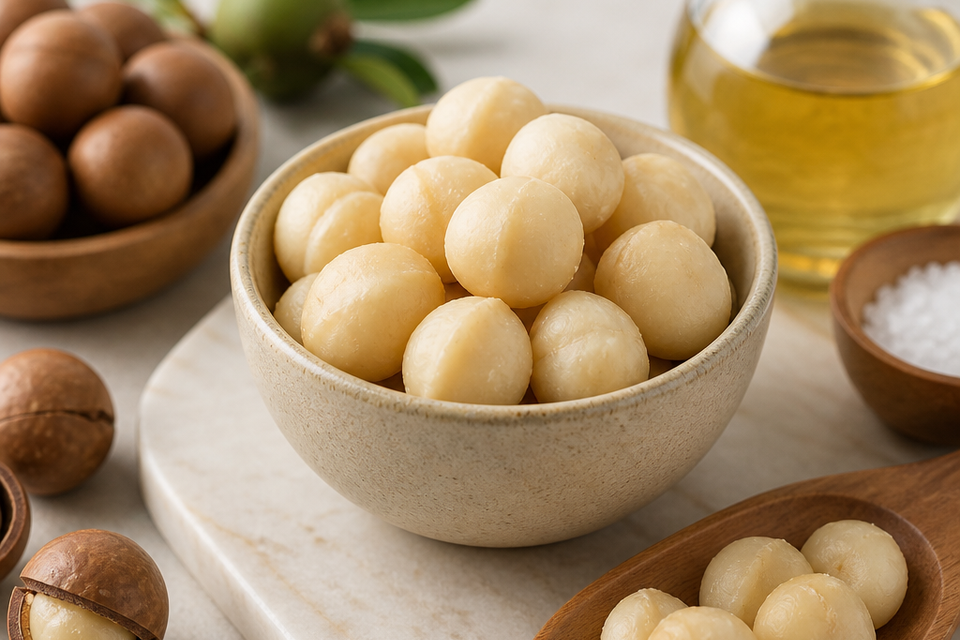
One serving of macadamia nuts is calorie-dense but rich in monounsaturated fat, with meaningful amounts of thiamin, manganese, and magnesium. For formulators and buyers, this profile supports “good source of” claims for specific nutrients, but check your regional labeling rules before making them.
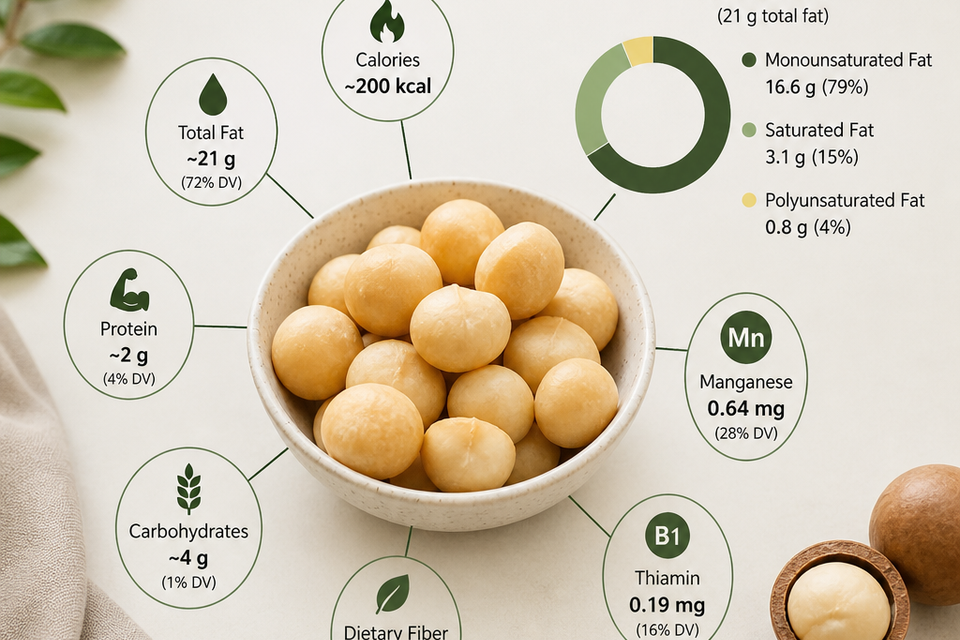
A one-ounce serving of macadamia nuts is calorie-dense and high in monounsaturated fat, with meaningful amounts of manganese and thiamin. Portion size is the key factor when fitting them into a daily diet.
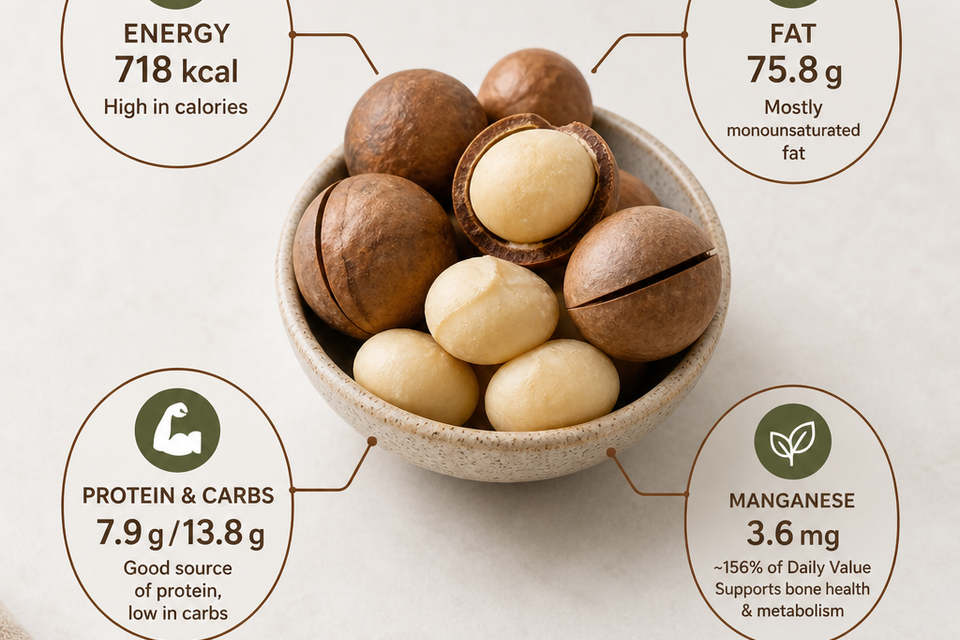
Macadamia nuts are calorie-dense, and most of their fat is monounsaturated. Per 100 g they deliver a large share of your daily manganese, so portion size is the main factor in how they fit into a balanced diet.
A 1 oz (28 g) serving of raw macadamia nuts provides about 204 kcal, 21.5 g fat, and 2.2 g protein. This single serving figure is the most useful anchor for comparison because it is a standard weight, it is easy to weigh in a quality control lab, and it can be converted to other bases with simple arithmetic. Everything else in this guide builds from it, so it is worth understanding exactly what it represents before you use it on a spec sheet or a nutrition panel.
The figure describes raw macadamia nuts, not roasted, salted, coated, or flavored products. Processing changes the weight and sometimes the composition. Roasting drives off moisture, which means a gram of roasted nut contains a slightly different mix of components than a gram of raw nut. Added oils, sugars, salt, or coatings add their own energy and nutrients. If your product is anything other than plain raw nuts, the 204 kcal figure should not be carried over without checking the formulation and the data source for that specific product.
It is also important to separate energy from the other values. The calorie figure reflects the combined energy from the fat, protein, and carbohydrate in the sample. Macadamias are dominated by fat, which is why the fat figure (21.5 g per ounce) is high and why the energy density is high too. Protein is comparatively small at 2.2 g per ounce. When someone describes macadamias as “energy-dense,” that is the reading that matches the numbers: a small weight carries a large amount of energy.
For procurement and R&D work, the practical rule is to record the serving figure together with its basis. A useful note in a specification file reads something like: raw, shelled kernels, 28 g serving, with the source and the date of retrieval. Without that context, a figure can be quoted correctly and still be applied to the wrong product. Keeping the basis attached to every number is the simplest way to avoid mismatched comparisons across suppliers and across internal documents.
The 1 oz serving also gives a convenient reference for checking other claims. If a supplier quotes a per-ounce figure that differs substantially from 204 kcal, the first question should be whether the product is the same. If the product is the same, the next question is whether the quoted figure was measured on a comparable sample or taken from a generic database entry. Either way, a single trusted reference point makes discrepancies easier to diagnose.
The serving figure should also be read alongside the actual weight of the product in the pack. Many macadamia products are sold by weight rather than by count or volume, so the weight declared on the label is what matters for the nutrition panel. If your product is sold in bags of a stated net weight, the per-serving values on the panel must follow the serving size rules for your market, not simply the number of nuts that fit into a cup or a handful.
Finally, the 1 oz anchor helps with internal consistency. When the same figure is used across a product sheet, a sales deck, a nutrition panel, and a website, the numbers agree. When different teams use different sources, the numbers drift. Choosing one verified serving figure as the internal reference and converting everything from it is a good control measure for any business that handles macadamia nuts at scale.
In short, the 1 oz (28 g) figure of about 204 kcal, 21.5 g fat, and 2.2 g protein is a sound starting point for raw macadamia nuts. It is most valuable when its basis is stated clearly, when it is applied only to products that match that basis, and when it is used as the common reference for every other conversion in your documentation.
The second step is to understand the serving unit options that people commonly use. Macadamia figures are often given per 1 oz, per 10 to 12 kernels, per nut, per cup, per 5 oz, and per 100 g. These are not interchangeable. Each unit answers a different question. A per-ounce figure supports a weight-based label. A per-kernel figure can help consumers who count nuts. A per-cup figure is a volume measure, and volume is sensitive to how the nuts are packed, whether they are whole or chopped, and how much air sits between them. A per-100 g figure is useful for comparing products on a standard basis that is independent of serving size.
The per-100 g basis is the most useful for technical comparison because it removes the influence of serving size. Using the verified 1 oz figure, the arithmetic is direct. One ounce is 28 g, so 100 g is roughly 3.57 times that serving. Multiplying the 1 oz values by that factor gives approximately 728 kcal, 77 g of fat, and 7.9 g of protein per 100 g. These are derived values from the verified serving figure, not separately sourced data, and they should be labeled that way if they are used in documentation.
The per-5 oz basis is where comparisons often break down. Scaling the 1 oz figure by five gives roughly 1,020 kcal per 5 oz. The figure of 1,150 kcal per 5 oz that appears in community discussions is higher than this scaled value. That gap does not automatically mean the higher figure is wrong, since it may reflect a different product form, a different moisture basis, a different measured sample, or a different database entry. But it does mean the figure cannot be accepted as a direct equivalent without checking its source and product description.
The per-cup basis is the least reliable for cross-supplier comparison unless the weight of the cup is stated. Volume measures depend heavily on how nuts are poured or packed and on whether they are whole, halved, or chopped. A quoted figure of 1,000 calories per cup cannot be checked against the verified 1 oz serving without knowing the weight of the cup it describes. If a supplier or a blog provides a per-cup value, ask for the weight in grams and the product form. Without those, the figure should be treated as unverified for technical use.
The per-nut basis has the same problem in a different form. Macadamia kernels vary in size, and a per-nut figure only makes sense if the average weight of a kernel from the same lot has been measured. Counting kernels in a handful is a useful consumer approach, but it does not produce a precise technical value. For a nutrition panel or a specification, a per-nut figure should be derived from a weighed sample of counted kernels, and the sample description should be recorded.
The 10 to 12 kernels basis sits between the per-nut and per-ounce approaches. It is often used in consumer content because it is easy to picture. For internal documentation, it should be converted from weight rather than estimated by counting. If you use it, state the average kernel weight behind the conversion so that the calculation can be reproduced by someone else in your organization.
The safest practice is to choose one primary basis for each document and to convert other bases only from the primary figure. For most food businesses, the primary basis should be the serving weight that matches the label, with the per-100 g value included as a standardized reference. Every other unit should be presented as a conversion, with the arithmetic or the source shown. This prevents the kind of silent substitution that causes conflicts between an internal spec and a published claim.
Rounding also deserves attention. Calorie values are typically rounded for labeling, and rounding at one stage of a calculation can shift the final figure at another stage. When scaling from 1 oz to 5 oz, use the unrounded underlying value if you have it, and round only at the end. Keep a record of the rounding rule your organization uses so that figures remain consistent across revisions.
In practical terms, the question to ask about any macadamia calorie figure is not just “how many calories?” but “calories per what, and measured on what product?” Once the unit and the product are clear, most apparent contradictions disappear. Where they do not, the conflict usually points to a difference in sample, moisture, or source rather than to a simple arithmetic error.
The source of a nutritional figure matters as much as the figure itself. Nutritional values for foods can come from several types of origin: analytical testing of a specific product, a published national or institutional food composition database, a supplier’s technical sheet, a manufacturer’s label, or an informal online source. Each carries a different level of traceability. A figure from a specific laboratory analysis of the product you sell is usually the most reliable for your own nutrition panel. A database value describes a generic food and may not match your product’s form or processing.
When you receive a macadamia figure from a supplier, ask where it came from. A good supplier can usually tell you whether the figure is from a lab analysis, a reference database, or a calculated value from ingredient data. If the answer is unclear, treat the figure as provisional. Provisional figures can still guide early decisions, but they should not be used on a label or in a public claim until they are confirmed.
For internet sources, the review process should be stricter. Community threads, recipe sites, and fitness forums often present numbers without stating the serving basis, the product form, or the data source. A figure such as 1,000 calories per cup may be a reasonable estimate for one scenario and an error for another. Without a stated basis, it cannot be used to validate a specification. Flag any such figure as untraceable in your documentation, and do not allow it to replace a verified value.
Another useful check is consistency across units. If a source gives a per-ounce value and a per-100 g value, convert one to the other and compare. A large mismatch suggests either a different product, a mistake in the source, or a different basis for one of the values. The same test applies to per-cup and per-5 oz figures. When the internal arithmetic does not agree, the source needs a second look before you use it.
Documentation should record the source, the product description, the basis, and the date the figure was retrieved or tested. This record is what allows a future reviewer to check the number without repeating the entire investigation. For regulated labeling, the record also supports the claim that the panel values were determined by an accepted method or taken from an acceptable reference, depending on the rules in your market.
Where your business depends on a figure for a public claim, consider commissioning or requesting laboratory analysis of the actual product. This is more costly than using a database value, but it removes ambiguity about moisture, fat content, and processing effects. For a bulk ingredient supplier, requesting a certificate of analysis that includes the relevant nutritional parameters for each lot is a practical alternative. The exact requirements depend on your market, the product form, and your own quality systems.
Finally, keep the verification trail updated. Suppliers change products, roasting profiles change, and databases are revised. A figure that was accurate when a specification was written may no longer match the product in the next shipment. A simple review schedule, tied to supplier changes or new analytical results, keeps your nutritional data aligned with what you actually sell.
For a nutrition panel, the figures must match the product that will be sold, the serving size declared on the label, and the rules that apply in the market where the product is distributed. Serving sizes are typically based on reference amounts customarily consumed, and the declared serving should be consistent with those rules. A panel that uses a per-ounce value for a product whose label serving is a different weight will be inconsistent, even if the underlying arithmetic is correct.
The practical workflow is straightforward. Start with the verified figure for the product form you sell. Confirm the declared serving weight. Calculate the panel values for that serving using the verified per-gram or per-serving data. Round according to your market’s rules. Then check that the per-100 g values, if displayed, are consistent with the panel values. Any discrepancy should be traced back to the source before the label is approved.
Regulatory definitions for nutrient content claims differ by country, and they can change. Terms that describe the level of a nutrient, such as expressions of fat or protein content, are typically tied to specific thresholds defined per serving or per reference amount. Before using any such term, check the current rules in your target market and confirm that your product meets the required threshold on the basis the regulator uses. Do not rely on a general statement that macadamias are high in fat or a good source of protein without checking these definitions.
The fat figure is especially important to handle carefully. Macadamias are high in fat, and that is a central fact in any nutritional description of the product. However, a product’s fat content claim should reflect the declared serving on the label, not the raw figure per ounce unless the serving matches. Similarly, protein content claims must match the protein value in the panel for the same serving and the same basis.
Brands should also be careful about comparative claims. A statement that a product has fewer calories or less fat than another food is a comparative claim, and it requires that the compared products be on the same basis and that the comparison is accurate and documented. Comparisons between macadamias and other nuts, or between macadamias and other snacks, need a shared serving basis and a verified source for each figure. Without those, a comparative statement can be challenged even if it seems intuitively correct.
Health claims require a different level of scrutiny than nutrient content claims. A health claim links a food or a nutrient to a health-related outcome. These are subject to specific rules in many markets, and they often require a defined scientific basis and an approved wording. A general statement that macadamias are part of a healthy diet, or that they contribute to heart health, may fall into this category and may not be permitted without qualification or approval. Any claim of this type should be reviewed against the regulations and the evidence requirements that apply in the relevant market before it is used.
Because this article is focused on the nutritional values and the basis of comparison, it does not provide a list of approved health statements. What it can do is set out a safe internal process. Before a health-related statement is used, confirm the exact wording, the target market, the nutrient or food it refers to, and the evidence the regulator accepts for that wording. If any element is uncertain, the statement should be held back until a qualified reviewer has assessed it.
A good practice is to separate three types of statements. The first is a factual description of the nutritional content, such as the energy and fat in a stated serving. The second is a nutrient content claim, such as a term describing the level of a nutrient, which must meet defined thresholds. The third is a health claim, which connects the food to a health outcome and carries stricter requirements. Mixing these types in a single line of marketing copy is a common source of compliance problems.
Brand teams should also watch for implied claims. Images, product names, taglines, and context can suggest a health benefit even when no explicit claim is made. A product image showing a fitness setting or a taglines that imply weight control can be read as a claim by a regulator or a consumer. Review the entire package and all marketing materials, not only the nutrition panel and the headline claims.
If a supplier provides marketing claims as part of a product sheet, verify them independently before adopting them. A supplier’s statement is not automatically compliant in your market, and it may have been written for a different jurisdiction or a different product. Your own review and, where appropriate, legal or regulatory advice should decide what can be used.
The nutrition panel and the marketing claims must tell the same story. If the panel shows a fat value that is high, a claim describing the product as low in fat would be inconsistent and misleading. Consistency between the panel, the claims, and the product specification protects the brand and reduces the risk of corrections or enforcement action. An internal sign-off process that checks these three elements together is a reasonable control for most businesses.
For businesses that sell macadamias in multiple markets, the complexity increases. Serving size conventions, nutrient content thresholds, and health claim rules can differ between jurisdictions. A single product may need different labels or different claims in different markets. Build a market-by-market checklist so that the same product is not assumed to be compliant everywhere simply because it is compliant in one place.
The following sequence can help a team move from data to a compliant claim. First, confirm the product form and the verified nutritional data for it. Second, establish the serving basis required by your market. Third, calculate the panel values and any derived per-100 g values, recording the arithmetic. Fourth, identify every statement you want to make, sorting them into factual description, nutrient content claims, and health claims. Fifth, check each statement against the rules in each target market and confirm the evidence requirements. Sixth, review the full package and all marketing for implied claims. Seventh, obtain sign-off that records the sources and the decisions.
This process takes time, but it reduces the risk of errors that are expensive to fix after printing or launch. It also creates a documented trail that supports future product changes. When a supplier changes its macadamia product, or when a new roasting method is introduced, the same process can be repeated, with the earlier record showing what changed and what must be reviewed again.
As a general rule, avoid any statement that cannot be traced to a verified figure and an approved wording. Where a statement is useful for marketing but cannot yet be supported, it is better to leave it out than to publish it and correct it later. Accurate, plain descriptions of the product’s nutritional profile are often more credible with buyers than broad health language.
Returning to the original question of conflicting calorie numbers, the practical resolution is now clear. A figure per 1 oz of raw macadamia nuts, about 204 kcal with 21.5 g fat and 2.2 g protein, is a verified reference point. Figures per cup, per 5 oz, per nut, or per 10 to 12 kernels must be converted from a stated weight and a stated product form before they can be compared. Where the conversion does not agree with the verified value, the source should be investigated rather than accepted or dismissed.
For procurement, the approach is to request the product form, the serving weight, the source of the nutritional data, and the basis of any per-cup or per-kernel figure. For R&D, the approach is to use the verified per-gram values for formulation and to confirm the final panel with analysis of the finished product where needed. For marketing and compliance, the approach is to restrict claims to those that match the panel, meet the thresholds for the target market, and are supported by an approved wording.
The resulting documentation should be simple to audit. A reviewer should be able to see the product description, the source of each value, the conversion method, the rounding rule, the serving basis, and the claims that rely on each value. If any link in that chain is missing, the figure should be flagged until the gap is closed. This approach keeps the discussion grounded in facts rather than in competing numbers from unknown sources.
In summary, macadamia nutrition figures are simple to use once their basis is clear. The verified 1 oz figure provides a dependable anchor, conversions to other units require stated weights and product forms, supplier and online figures need traceable sources, and health or nutrient claims must follow the rules of each market. Applying these steps consistently is the best way to make accurate comparisons and to write labels and marketing that stand up to scrutiny.
Conclusion
The main takeaway is simple: before you compare any two macadamia specs, confirm they use the same serving basis. Most apparent contradictions come from mismatched units, not conflicting data. Use one conversion standard across suppliers, flag any figure you can’t trace to a source, and make sure your nutrition panel and marketing claims follow the same basis.
In practice, that means anchoring your documentation to a verified serving figure, recording the product form and source with every number, and converting other units only from a stated weight. It also means treating per-cup and per-kernel figures as unverified until the underlying weight is known, and checking any large gap between a supplier’s figure and your own scaled calculation before accepting it.
Before any nutrient content term or health-related statement goes on pack or into marketing, check the wording and thresholds that apply in each target market, and review the full package for implied claims. If a statement cannot be traced to a verified figure and an approved wording, leave it out until it can.
If you’re shortlisting suppliers, send your target specs and the serving basis you need to our team. We can share product data and help you compare options on the same terms. You can also request a bulk nut quotation to see how pricing and specs line up for your product.